While
there are many different ideas on what style in architecture should mean, there
are several common treads throughout the movements from the late 1800s to the
early 1900s. The emerging modernism was fostering new ideas and schools of
thought. There was a strong desire to create an entire new style which differed
for each country. A break from the overuse of ornamentation allowed materiality
to drive design. This can be seen in different ways throughout all the
movements. Some rejected
Industrialization and used nature as the main theme in design, while others
focus of using materials in new and innovative ways. Either way, a strong sense
of materiality is a common thread of emerging modernism of the late 1800s to
the early 1900s.
The
Arts and Crafts Movement was in contrast of Industrialization. Beginning in the
late 1800s, the Arts and Crafts style was driven by nature and natural themes.
The use of natural material such as wood, brick and stone, in very conventional
ways, grounded this movement. William Morris was an Arts and Crafts designer
and creates many types of furniture and wall paper prints with these ideals.
Craftsmanship was very important to these designers who openly rejected
Industrialization, preferring the detail and emotion of crafted products. Materials
were used in ways to express the beauty of the natural, not the machinery of
industry. The ornamentation was simple, geometric forms showcasing the natural
beauty of materials.

William Morris Chair
Another
movement inspired by Nature is the Art Nouveau Style, popular in Europe in the
early 1900s. This movement was also heavily inspired by Nature but, unlike the
Arts and Crafts, did accept industrial methods in production. The ornamentation
was not overpowering but fluid single lines. Iron work became a popular new
material. The thin, delicate appearance of the Iron used for railings and
decoration was inspired by nature but also embraced the mass-production of
industry. Form and Ornamentation blurred together so the building itself was
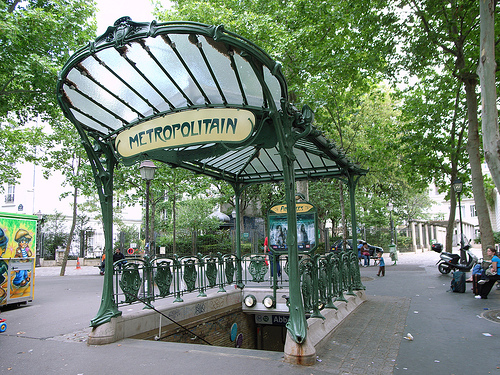
detailed. Hector Guimard was a very popular French Art Nouveau artist. His
railings were extremely ornate and designed with natural lines. He is best
known for the Paris Metro Station, which employs intensely detailed Iron
carvings.


Paris Metro Station - Guimard
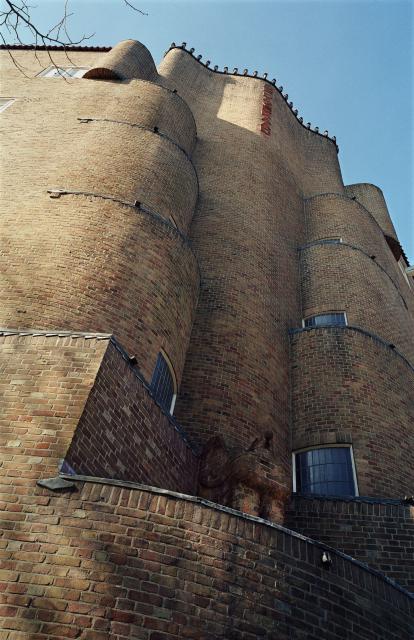
The Amsterdam school was based in
the Netherlands. This design approach is similar to the Arts and Crafts. There
was a constant use of natural materials but these materials were used in a more
innovative way. The plasticity of brick was explored. Michel de Klerk and Piet
Kramer exemplified this in there deign for a housing project. The bricks curve
and undulate over the façade, also changing their materials because of such an
unconventional application. Ideas are expressed through the materials. Large
interior volumes showcase the feelings of inclusion and betterment of a society
through contact with the arts.

Michel de Klerk and Piet Kramer, De
Dageraad housing project
The de Stijl movement was the first
to really break away from the connection to nature. There is a direct rejection
of nature as a guiding principle of nature. Instead this movement focused on
total abstraction and a complete break from tradition of ornamentation in any
form. Mondrian’s paintings had a strong influence in the abstraction of facades
into planes and the use of primary colors. In terms of materiality the
materials were not noticeable. The point was to have the building blend as
simple geometry. The use of natural materials like wood, or brick, would have
distracted from the concept. The materials used were painted and devoid of
decoration to make the focus about the composition of the whole.
The Rietveld-Schroder house is a
great example of the formation of planes and use of colors to define the
building.

Rietveld-Schroder House
Futurism in Italy was driven by a
desire for powerful architecture. The sketched designs were brutal and harsh.
There were large, overwhelming monuments highlighting a devotion to industry.
The material choices reflected these ideals. Antonio Sant'Elia created many
sketches of Italian Futurism for an exhibition in Milan. Large amounts of
concrete, steel and glass were used in monumentally scaled designs. Industry
was almost worships and the materials came straight for factories. A total
abandonment of tradition allowed for the development of new technologies and
material uses to play a crucial role in the architecture.

Sketch by Antonio Sant'Elia
Russian Constructivism is very
similar to Italian Futurism in their rejection of natural materiality. The
Soviet Union, at the time, was using their architecture to promote the social
and political values. Communal values of society were becoming more important
than the individual which can even been seen in the architecture. Scale was
monumental. Buildings contained all aspects of life and were designed to be
entered by the masses, marching in formation. There was a use of “strong”
materials such as concrete, glass and extensive steel. Each material used
evoked a feeling of smallness on visitors because the coldness of compositions.

Vesnin Brothers
The Bauhaus Movement is an important
one for the comparison of materials. The Bauhaus was one of the first schools
of design to use color and material changes to define interior programmatic
elements on the exterior. These can be seen in the school for the Bauhaus,
designed by Walter Gropius. This school has a glass and steel curtain wall
covering the multiple stories of the studio. There is a grey-tone stairwell and
simple white boxes for the living spaces and technical school. These material
choices defer from nature but are not as harsh as the Italian and Russian
explorations into modernism.

Bauhaus School, Walter Gropius
Adolf Loos represents another view
of a t=naturalistic approach to design. Similarly to the de Stijl movement,
Loos hated ornamentation and believe it was a waste of a craftsman time.
Instead, he wanted pure forms and simple expression of materials. He valued the
craftsman but also did want to waste time on minor details. Loos used a lot of
marble and reflective materials in his facades. He also used wood and natural
materials in very natural and expressive ways.

Adolf Loos, House on
Michaelerplatz
http://www.galinsky.com/buildings/michaelerplatz/michaelerplatz3.jpg





No comments:
Post a Comment